

There’s something undeniably elegant about well-layered jewelry. It’s the difference between looking put-together and looking like you actually tried—which, ironically, is the whole point of effortless style. When done right, layered jewelry adds dimension and personality to any outfit without feeling overdone. The key isn’t adding more pieces; it’s understanding how to combine them thoughtfully.
Many people think jewelry layering has strict rules: too many necklaces look like clutter, stacking rings looks tacky, and mixing metals is absolutely forbidden. But when you look at how truly well-dressed people approach jewelry, they’re not following rules at all. What they’re actually doing is something simpler: they’re being intentional. They’re choosing pieces that speak to each other, respecting proportion, and committing to the look. In this guide, we’re breaking down exactly how to do it—so you can master layered jewelry with confidence.
Disclosure: This post may contain affiliate links. If you make a purchase through them, TheStyleArc may earn a small commission at no extra cost to you. Read our full Affiliate Disclosure.
Why Layered Jewelry Is More Popular Than Ever in 2026
Minimalism had its moment, but we’re officially in the era of intentional maximalism. The difference? One feels effortless; the other feels forced. What’s changed in the jewelry world is that people are craving more personal expression, more texture, and more of those “wait, how did she make that work?” moments.
Part of this shift comes from a move away from single-statement pieces toward curated collections. Instead of investing in one expensive necklace, modern styling favors building layers that work together—sometimes coordinating in color and metal, sometimes playing beautifully against each other. It’s about telling a more complete story with your accessories.
Social media has played a role too. Styling platforms now showcase real people wearing jewelry they actually own rather than editorial spreads with pieces borrowed for a single shoot. This has normalized the “layered drawer approach”—mixing vintage finds, heirloom pieces, and affordable favorites in ways that feel authentic rather than curated.
The beauty of this trend is that it’s democratic. You don’t need expensive jewelry to layer successfully. What matters is understanding the principles: proportion, metal harmony, and knowing when to let one piece be the star.
The Essential Elements of Jewelry Layering: Breaking Down What Actually Works
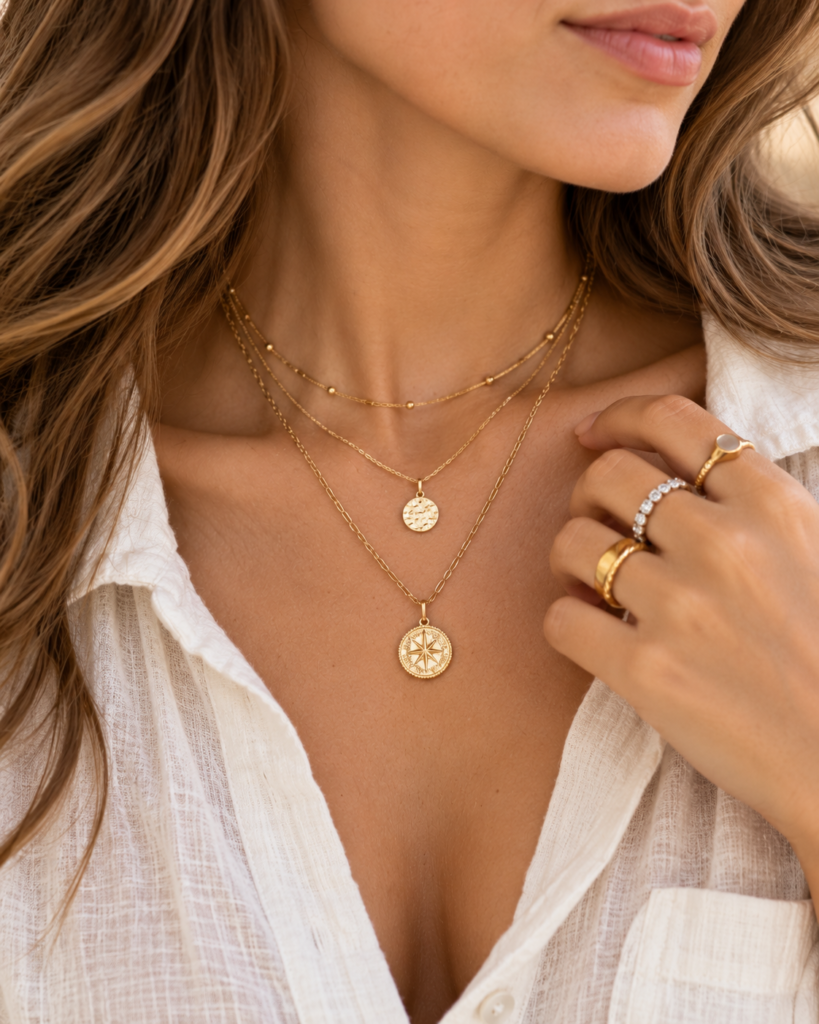
Looking at this layered jewelry combination, a few things become immediately clear. The person wearing it didn’t just throw on random pieces and hope for the best. There’s a logic to how these items work together. Let me break down what makes this specific combination successful and how you can apply these principles to your own jewelry collection.
Layered Necklaces: The Foundation of the Look
This is where the entire look starts. You can see three distinct chains here, each at a different length, and each with its own personality. The thinnest one sits highest, with delicate metal beads spaced throughout. The middle chain is slightly heavier and sits lower at the collarbone. The third drops even further.
This length variation is what prevents layered necklaces from looking like a tangled mess or a choker situation. When chains sit at different heights—one hitting at the collarbone, another at mid-chest, a third at the breastbone—they create visual rhythm instead of visual confusion.
The beaded elements matter more than you’d think. Small metal beads or pearls spaced along a delicate chain break up the monotony of plain links. They catch light differently and add a level of sophistication that plain chains alone can’t achieve. This isn’t about adding bulk; it’s about adding texture.
The metal tone here leans warm—bronze and copper tones rather than bright silver. This warm palette then influences how you’d choose your other pieces. It’s not a hard rule, but when your necklaces establish a warm metallic tone, your rings and earrings should generally play in that same temperature range to feel cohesive.
Statement Rings With Purposeful Supporting Pieces
This angle shows what makes ring stacking actually work. The blue topaz oval cut gemstone ring with its diamond halo is clearly the star. It has presence without being obnoxiously large. The cut—that elongated oval—reads as sophisticated and slightly vintage-feeling, which gives it personality beyond just “big shiny stone.”
Around it are textured gold bands. Notice they’re not plain polished rings. The texture—whether it’s lattice, woven, or hammered—gives each supporting ring its own character. A plain gold band next to a gemstone ring looks like afterthought stacking. A textured band looks intentional.
The width matters too. You’re not seeing five thin bands squeezed onto one hand. You’re seeing maybe two or three bands of varying widths, which creates visual breathing room. Each ring is distinct. You can see it. It’s not a solid mass of metal.
And notice the wooden earring visible in this shot—a round wooden drop that’s organic and natural. This is the smart move: when you’re committing to precious metals and gemstones, introducing one organic material (wood, pearl, resin) prevents the whole look from feeling too formal or too “try-hard.”
How All the Pieces Work Together
From the front, you can see the complete picture. The layered necklaces cascade down the neckline, creating movement and visual interest. The hand shows multiple gold rings, but because they have texture and are spaced intentionally, they don’t look like a jewelry store exploded on one hand.
Notice how the warm gold of the rings echoes the warm tones in the bronze necklaces. There’s a color story being told here. This isn’t an accident. When you’re planning to layer jewelry, color and metal harmony matter. It’s not enough to just own nice pieces; they need to speak the same language.
The patterned top beneath everything—black with multicolored geometric shapes—is the perfect canvas for this jewelry. It has visual weight without being loud. The jewelry stands out because the clothing isn’t competing for attention. This is an important practical note: when you’re wearing layered jewelry, your clothing can be patterned but shouldn’t be overly busy or demand its own spotlight.
When and How to Wear Layered Jewelry: Adapting Your Look for Different Situations
Casual Day: Office-Ready Jewelry Layering
If you love layered jewelry but worry about it looking too dressed-up for an everyday setting, take comfort in this: layering doesn’t have to mean maximal. You can absolutely layer jewelry in a professional environment.
For a workday look, the approach is to scale down the volume while keeping the layering concept. Two necklaces instead of three. Two rings instead of four. Small earrings. The combination still reads as intentional and thoughtful—which actually reads more professional than a single piece of jewelry. You look like someone who considered what they’re wearing.
The key for office settings is choosing a consistent metal tone. Yellow gold with other gold pieces, or silver with other silver pieces. While mixing metals can look amazing (as we see in this full-volume layering look), office settings sometimes call for a slightly more conservative approach.
Evening/Date Night: Where Layered Jewelry Truly Shines
This is the sweet spot for layered jewelry—and actually, this photo we’ve been analyzing is perfect for this moment. Multiple necklaces at varying lengths, a significant gemstone statement ring with supporting rings, warm metallic tones, and organic touches like wooden earrings. This is “dressed up but not formal” territory.
Evening is when you can go fuller with your layering. Three necklaces feel celebratory rather than busy. Multiple rings feel intentional rather than careless. The blue topaz ring becomes the centerpiece, drawing the eye to your hands and neck—which is exactly where you want attention during an evening look.
Casual Weekend: Freedom to Experiment
Weekend is your testing ground. This is where you wear combinations you wouldn’t commit to during the work week. Maybe you layer three necklaces when you’d normally do two. Maybe you try mixing metals you’ve been nervous about. Maybe you stack four rings and see how it feels.
Weekend styling is lower stakes. You’re not worried about it reading a certain way professionally. You’re just trying things on and seeing what makes you feel good. Often, the combinations you discover on weekends become your go-to layering formulas for more important occasions.
Metal Harmony in Layered Jewelry: The Bronze-to-Gold Approach
The jewelry in these photos does something really smart: it establishes a warm metal palette from the start. The necklaces are bronze or copper-toned, not bright silver. The rings are gold. This creates immediate harmony—everything speaks the same metallic language.
This is actually the easiest path to successful metal mixing. Start by choosing a temperature (warm or cool) and stick with it. Warm metals include gold, rose gold, bronze, and copper. Cool metals include silver, white gold, and platinum. Pick one temperature family and layer within it.
Here’s the thing about mixing metals within the same temperature family: it actually looks more sophisticated than matching exactly. Two different warm tones (bronze necklaces with gold rings) creates visual interest and texture. It reads as intentional layering rather than accidental mismatched pieces.
How Gemstone Color Influences Metal Choices
The blue topaz in this styling is cool-toned, which might make you think “pair it with silver.” But here’s what actually works: the gemstone is the coolness in the outfit. Everything around it—the warm bronze and gold metals—makes the cool blue stone pop even more. It’s about contrast and balance, not perfect matching.
If you’re building jewelry combinations, think about this: your gemstone color doesn’t have to match your metal tone. In fact, slight contrast often works better. A cool-toned gemstone with warm metals creates visual tension that’s actually pleasing to look at.
| Gemstone Color | Works Well With | Why It Works |
|---|---|---|
| Blue Topaz / Blue Sapphire | Gold, bronze, warm metals | Cool stone contrasts beautifully with warm metal |
| Emerald / Green Tourmaline | Gold, rose gold, yellow metal | Green and gold is classic for a reason |
| Ruby / Red Garnet | Yellow gold, rose gold, warm metals | Red glows in warm metallic settings |
| Diamond / Clear Stone | Any metal—works universally | Neutral stones pair with everything |
Building Your Complete Look: How Clothing Supports Layered Jewelry
This photo is the perfect case study: a black top with a small geometric pattern in multiple colors, paired with bronze and gold layered jewelry. Here’s why it works, and what you can learn from it for your own styling.
Patterned Tops Can Work—With the Right Balance
The top here has pattern—small multicolored geometric shapes on black—but it doesn’t compete with the jewelry. How? Because the pattern is small-scale and not densely packed. The eye can still focus on the jewelry layering at the neckline and hands.
The rule isn’t “never wear patterns with layered jewelry.” The rule is “choose patterns that don’t demand all the attention.” Small geometric prints, subtle textures, or medium-scale patterns work fine. What doesn’t work is a large, bold graphic print that pulls focus away from your jewelry.
The Color Foundation Matters
Black as a base color is basically jewelry-neutral. It doesn’t compete with warm metallics, cool gemstones, or any other jewelry tone. Black becomes a stage for your accessories to perform. This is why black clothing paired with layered jewelry is such a reliable formula.
That said, other neutral base colors work equally well: white, cream, gray, navy. The principle is the same—neutral clothing creates a backdrop, and your jewelry becomes the focal point.
The Neckline Situation
Notice the neckline here isn’t extremely low or extremely high. It’s a standard top neckline. This is actually ideal for layered necklaces because the chains sit on skin and fabric equally, creating depth. Very high necklines compress the layering effect. Very low necklines compete with chest jewelry. A standard crew neck or slightly lower neckline gives layered necklaces room to breathe.
Sleeve Length and Hand Visibility
This appears to be a sleeveless or short-sleeved top, which means hands and wrists are fully visible. This is important for stacked rings to shine. If you’re wearing long sleeves that cover your knuckles, your ring stacking gets hidden. When you’re investing in beautiful layered rings, you want them seen.
Jewelry Layering Mistakes That Make the Whole Look Fall Apart
Mistake #1: Competing Statement Pieces The most common error people make is treating every piece like it needs to be a statement. In this photo, the blue topaz gemstone ring is the clear star. Everything else—the supporting rings, the necklaces, the earrings—all support it rather than compete with it. If you have a large gemstone ring, keep your necklaces relatively delicate. If you’re doing bold layered necklaces, keep your rings minimal. You can’t have three different statement pieces all demanding attention at once.
Mistake #2: Too Many Pieces That Look Identical Three plain gold bands stacked look like you just grabbed whatever was in your drawer. Three bands with different textures—lattice, hammered, smooth—look intentional. Difference creates visual interest. Sameness creates confusion.
Mistake #3: Ignoring Wearability Stacked rings that spin and flip constantly are torture to wear. Before you commit to a stacking combination, sit with it. Do the rings stay in place? Can you actually grip things without them sliding around? If rings are constantly uncomfortable, you won’t wear them, which defeats the entire purpose.
Mistake #4: Chains That Tangle Constantly If three delicate chains layered together turn into a tangled nest by midday, something’s wrong. This usually means the chains are too similar (same weight, same chain style). Varied chain styles—beaded, standard link, box chain—actually tangle less because the different weights and textures catch differently on each other.
Mistake #5: Forgetting About Proportion and Scale If you have small, delicate hands, thick chunky rings might overwhelm you. If you’re a larger-framed person, paper-thin delicate chains might get lost. Jewelry layering should enhance your natural proportions, not fight them. Consider your frame when choosing which pieces to layer.
Mistake #6: Ignoring Your Skin Tone and Metal Undertones If you naturally look better in warm metals but you’re forcing yourself to wear silver-toned jewelry, it shows. The look feels slightly off even if you can’t explain why. Work with your natural skin undertones. Warm skin looks better with gold and bronze. Cool skin looks better with silver. This isn’t a hard rule, but it’s a useful guideline.
Building This Look on Your Budget: Where to Invest and Where to Save
The Investment Piece: A quality gemstone ring like this blue topaz with diamond halo is where you want to spend real money. This is the piece that gets commented on. This is the piece you’ll wear constantly. If you’re going to invest in one jewelry piece, make it your statement ring. Quality settings matter because loose stones or poorly set gemstones deteriorate over time. This is not the place to go cheap.
Delicate Necklaces Can Be Budget-Friendly: The beauty of layering delicate chains is that they don’t need to be expensive. Contemporary fashion retailers carry really well-made delicate chains at accessible prices. The difference between a $15 chain and a $100 chain is often not obvious when it’s layered with other pieces. Focus on finding chains with good clasps and solid links—functionality matters more than brand name.
Textured Supporting Rings: These don’t need to break the bank either. What matters is that the texture is defined and interesting. A textured band from a mid-range jeweler looks just as good layered as an expensive designer band. Again, good construction and secure sizing are what matter.
The Mixing Strategy: You don’t need to shop at one place. Your gemstone ring might come from a fine jeweler. Your delicate chains might come from a contemporary fashion brand. Your wooden earring might be vintage. Mixed sources actually create a more interesting layered look because each piece has its own story.
Start With What You Own: Before buying anything new, look at what you already have in your jewelry drawer. Can you layer existing chains? Do you have supporting rings that work with a nicer piece? Sometimes the best layered jewelry combination uses pieces you already own, just worn differently.
Build Slowly: You don’t need to acquire this exact look overnight. Start with one gemstone ring. Wear it for a month. Then add one delicate layered necklace. Wear that combination for a while. Then add supporting rings. Building slowly means you learn what you actually reach for and wear regularly, which is way smarter than buying a whole jewelry wardrobe at once and hoping you’ll use it all.
Your Jewelry Layering Questions Answered
Q: Can I really pull off layered jewelry if I have small hands?
A: Yes, but scale matters. Instead of three chunky rings stacked tightly, try two medium-textured bands with one statement ring. The principle is the same—proportion and intentionality. Small hands actually look more elegant with thoughtful layering than with single oversized pieces.
Q: What’s the difference between “layered” and “cluttered”?
A: The difference is intentionality and breathing room. Cluttered means every piece fights for attention. Layered means one clear focal point (the gemstone ring) with supporting pieces that enhance rather than compete. If you’re unsure, remove one piece. If the look is stronger, you had clutter.
Q: Should I layer necklaces if I have a short neck?
A: You can, but choose lengths carefully. Avoid having all three chains crowd at the collarbone area. Let one chain sit higher, one at collarbone, and one lower. This elongates the neckline rather than shortening it with a pile of chains at the top.
Q: How do I prevent layered necklaces from tangling while I’m wearing them?
A: Use varied chain types. A beaded chain tangles differently than a standard link chain. When you’re mixing three different chain styles (beaded, standard link, box chain), they actually stay separated because the different weights and textures don’t slide into each other. They catch differently on your skin.
Q: Can layered jewelry look professional at work, or is it just for casual/evening wear?
A: It depends on your workplace culture. In creative industries or business casual environments, layered jewelry looks polished and intentional. In conservative corporate settings, you might scale back to two necklaces and two rings instead of three and four. The principle stays the same; the volume adjusts to your environment.
The Bottom Line: Why Layered Jewelry Works
Looking at this complete styling—the multiple bronze-toned necklaces in different lengths, the blue topaz statement ring with its supporting textured bands, the wooden earring adding organic softness, all paired with a simple patterned top—you can see what successful jewelry layering actually looks like in real life.
It’s not complicated. It’s not expensive. It’s thoughtful. Every piece has a reason for being there. The metals tell a story (warm, cohesive), the necklaces create depth through length variation, the rings show personality through texture, and the overall effect is someone who clearly thought about what they were putting on.
That’s the real secret to pulling off layered jewelry: it doesn’t look like you grabbed random pieces from a drawer. It looks intentional. And that intentionality—more than the price tag or the materials—is what makes any jewelry combination look elevated and polished.
Start with one beautiful piece that you genuinely love. A gemstone ring, a quality chain, whatever speaks to you. Then, gradually build around it. Experiment with different combinations. Notice which pairings make you feel more like yourself. Trust what you see in the mirror. When your jewelry feels right, that confidence is what truly sells the entire look.
Related Articles to Explore
Build your complete jewelry and accessory knowledge: