

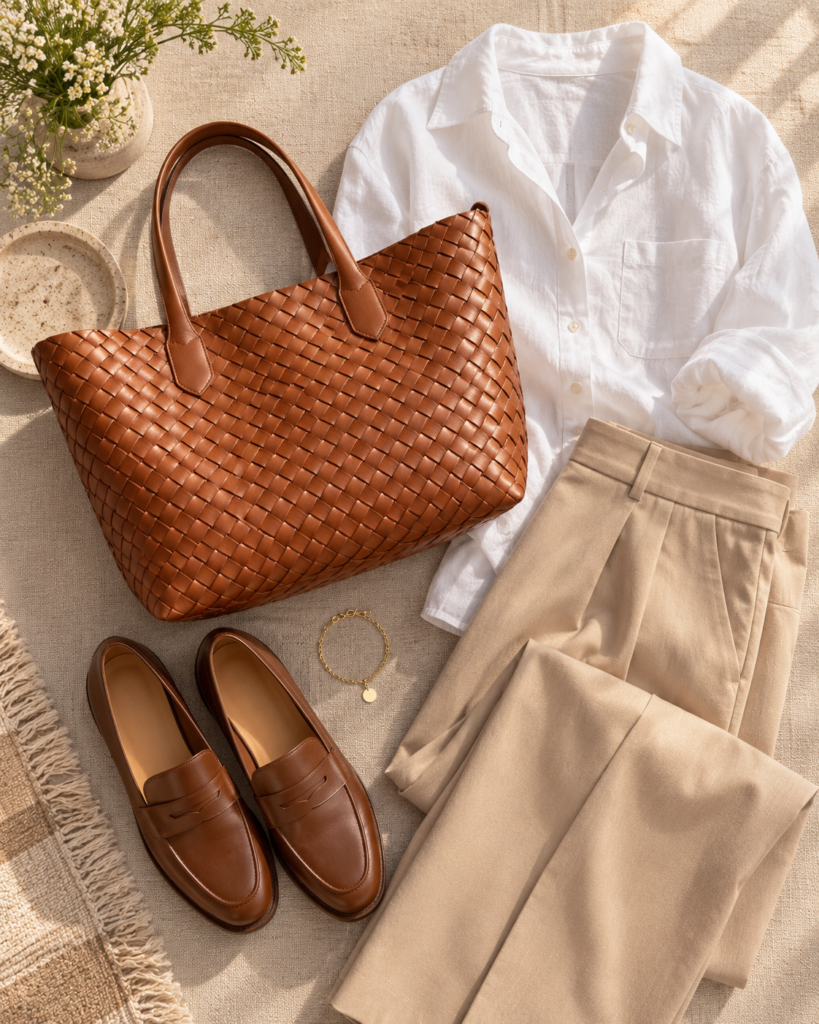
There’s a shift happening in how stylish women signal taste. For two decades, the language of luxury was the logo: the monogram canvas, the recognizable hardware, the brand name doing the talking. But walk through any fashionable neighborhood this summer and you’ll notice something different hanging from the most confident shoulders—bags with no logo at all. Just leather, woven by hand into dense herringbone patterns, in shades of cognac, chocolate, and deep forest green.
The woven leather bag is the defining accessory of the quiet luxury movement, and it’s worth understanding why. This isn’t about a trend cycle. It’s about a fundamental change in what we consider worth paying for: craftsmanship over branding, longevity over novelty, texture over logos. If you’ve been curious about these bags—or wondering whether they’re worth the investment—this is the deep dive you’ve been looking for.
Disclosure: This post may contain affiliate links. If you make a purchase through them, TheStyleArc may earn a small commission at no extra cost to you. Read our full Affiliate Disclosure.
Craftsmanship Is the New Status Symbol
Consider what a logo actually communicates: I bought this from a recognizable brand. Now consider what dense, hand-woven leather communicates: someone spent hours interlacing individual strips of hide into a structure that will outlast a decade of daily use. One is a purchase. The other is a value system.
This is the essence of quiet luxury—the idea that the most sophisticated signals are the ones only discerning eyes catch. A woven leather bag doesn’t announce itself across a room. But anyone who knows anything about leather goods recognizes the work instantly: the tight, even weave; the way the strips catch light at alternating angles; the structural integrity that comes from construction rather than stiffeners and glue.
There’s a psychological dimension too. Carrying a logo outsources your identity to a brand. Carrying craftsmanship keeps the statement personal: I chose this for what it is, not for what it says. In a fashion landscape saturated with recognizable everything, that restraint reads as the ultimate confidence.
The woven leather bag also solves the basket bag’s biggest limitation. Straw and raffia are charming but seasonal and fragile—one rainstorm, one overpacked afternoon, and they show it. Woven leather keeps the artisanal silhouette and handcrafted texture while adding the durability of a serious leather good. It’s the basket bag that grew up.
Why Texture Beats Logos in Real Outfits
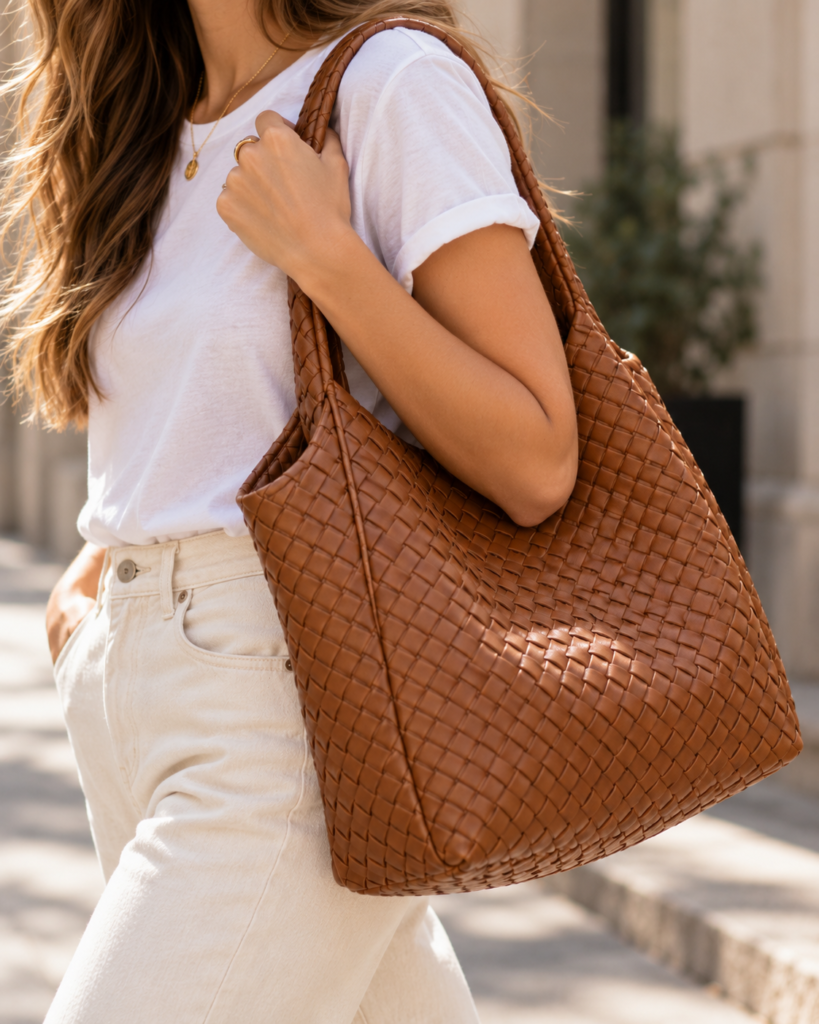
Here’s the practical proof of the craftsmanship argument: look at what happens when a woven leather bag meets the simplest possible outfit. A white tee. Off-white jeans. Flat sandals. On paper, that’s as basic as dressing gets. With a dark woven leather bag on the shoulder, the entire look reads as deliberate, expensive, and edited.
No logo bag achieves this effect the same way, because a logo adds information while texture adds depth. The herringbone weave gives the eye something to linger on—thousands of small shadows and highlights that a smooth bag simply doesn’t have. Against minimal clothing, that texture becomes the outfit’s entire point of interest, the way a single piece of sculptural jewelry can carry a plain dress.
This is why woven leather bags have become the unofficial uniform of women with pared-back wardrobes. The simpler your clothes, the harder your accessories work—and nothing works harder than visible craftsmanship.
The texture principle extends to how these bags interact with other leather accessories. A woven tote beside a smooth leather belt creates a conversation between finishes—same material family, different personalities. Notice how the deep brown weave, the burnished belt, and black mary jane flats form a coordinated leather story without a single matching logo. This is accessorizing at a more sophisticated level: coherence through material and tone rather than brand.
The Bag That Gets Better Every Year
Fast fashion trained us to expect accessories to peak on day one and decline from there. Woven leather inverts that curve entirely. New, these bags are handsome. Three years in—after beach days, commutes, and a hundred coffee runs—they’re beautiful in a way no new bag can be.
This is patina: the gradual deepening and softening that vegetable-tanned leather develops through handling, sunlight, and time. The high points of the weave burnish and darken. The leather relaxes into a suppler drape. Small variations emerge that make your bag observably yours. Where a straw basket at the beach is one season from fraying, a woven leather bucket bag absorbs the sun and sand and comes home better for it.
There’s a name for this in design circles: objects that improve with use rather than degrade. It’s the opposite of planned obsolescence, and it changes your entire relationship with the accessory. You stop babying it. You stop saving it. You carry it hard, and it rewards you.
Run the math and the investment logic becomes obvious. A quality woven leather bag costs more upfront than a straw basket or a trend bag. But divide the price by a decade of near-daily wear—the cost-per-wear calculation that smart shoppers apply to everything—and it becomes one of the cheapest accessories you’ll ever own. The trend bag you replace every eighteen months is the expensive one.
Choosing Your Shade: Cognac, Chocolate, or Forest Green
Woven leather bags live in a tight palette of rich, natural shades—and the one you choose shapes how the bag reads.
Cognac and tan are the warm, sunlit choices. They lean casual, pair effortlessly with whites, creams, and denim, and develop the most dramatic patina over time. If your wardrobe skews light and your style skews relaxed, this is your shade.
Chocolate and deep brown are the workhorses. Dark enough for city life and cooler months, rich enough to elevate basics, forgiving of daily wear. If you want one bag to carry year-round with everything, deep brown is the safest brilliant choice.
Forest green is the connoisseur’s pick. Unexpected without being loud, it functions as a near-neutral—stunning against white, cream, denim, and black—while signaling that you chose deliberately rather than defaulting. Against a white strapless dress and a wall of ivy, a deep green woven bag doesn’t match the moment; it completes it. Colored-but-quiet is perhaps the purest quiet luxury move of all.
The Minimal Wardrobe’s Perfect Partner
Because woven leather bags derive their interest from texture rather than color or hardware, they have a rare superpower: they work with prints and statements as easily as with basics. A leopard-print dress with matching mules is a maximal moment—and a tan woven basket bag grounds it perfectly, adding natural texture that keeps the animal print from tipping into costume. The same bag that anchored a white tee yesterday balances leopard today.
This is the capsule wardrobe argument in miniature. When one accessory flatters your plainest outfit and your boldest one, your entire closet gets more versatile. You need fewer bags, which justifies a better bag—and the cycle of intentional ownership reinforces itself. Quiet luxury isn’t really about price. It’s about this: fewer, better things, chosen for reasons a logo can’t provide.
What to Look For When You Invest
Examine the weave density. Tighter, more even weaves indicate skilled handwork and greater structural durability. Loose or irregular weaving (unless clearly a design choice) suggests corner-cutting.
Check the strip edges. Quality woven bags use leather strips with finished or burnished edges. Raw, fuzzy strip edges wear quickly and signal lower-grade hide.
Look inside. Many traditional woven bags are unlined, which is actually a mark of confidence—the weave is the construction, with nothing to hide. If lined, the lining should be stitched cleanly, not glued.
Test the handles. Handles take the most stress. On a well-made bag, they’re woven or anchored into the body’s structure, not merely stitched onto the surface.
Choose vegetable-tanned leather when possible. It’s the type that develops true patina. Heavily coated or corrected leathers stay static—they resist wear but never improve.
Caring for Woven Leather (It’s Easier Than You Think)
Part of the appeal is how little these bags ask of you. Dust occasionally with a soft dry cloth, working along the weave. Condition once or twice a year with a small amount of neutral leather conditioner to keep the strips supple. If the bag gets wet, let it air-dry naturally away from heat—vegetable-tanned leather handles moisture far better than straw ever will. Store it stuffed lightly with tissue if it will sit unused for months. That’s the entire regimen for a decade-plus accessory.
Your Woven Leather Bag Questions Answered
Q: Are woven leather bags only for summer like straw bags?
A: No—this is one of their biggest advantages. The artisanal texture feels summery, but leather in cognac, chocolate, or green transitions seamlessly through fall and winter. It’s a twelve-month bag with a warm-weather soul.
Q: Won’t the open weave let small items fall out or get wet?
A: Dense weaves are surprisingly enclosed, and many styles include a drawstring pouch or removable liner. For daily carry, a small interior pouch for essentials solves everything. As for rain, leather tolerates weather dramatically better than natural straw.
Q: How do I know if the weaving is actually handmade?
A: Handwoven bags show slight, organic variation in the weave under close inspection—machine-perfect uniformity across every strip usually indicates automated construction. Reputable makers are also transparent about their process; if craftsmanship isn’t mentioned, assume there isn’t much.
Q: Is the scratching and darkening normal?
A: Yes—that’s patina forming, and it’s the point. Surface marks on vegetable-tanned leather blend and burnish over time, becoming part of the bag’s character. If you want a bag that looks identical forever, choose coated leather; if you want one that becomes yours, embrace the change.
Q: What size should my first woven leather bag be?
A: A medium tote or basket silhouette is the most versatile entry point—large enough for daily essentials, structured enough for polish. Small bucket styles make beautiful second bags for outings and travel.
Q: Cognac or dark brown for a first purchase?
A: If your wardrobe is mostly light neutrals and denim, cognac. If you wear black regularly or want maximum year-round range, dark brown. You genuinely can’t choose wrong between them.
The Longest-Lasting Trend Is No Trend at All
The woven leather bag will never be the “it bag” of a single season—and that’s precisely its value. It sits outside the trend cycle entirely, belonging instead to the older, slower tradition of things made well: chosen for craft, kept for years, improved by use.
In a wardrobe context, it’s the rare accessory that elevates a white tee and balances a leopard print, that works at the beach and at dinner, that costs more on day one and less every day after. In a cultural context, it’s a quiet declaration that you no longer need a logo to feel the value of what you carry.
That’s the real luxury on offer here. Not the leather, not the hours of weaving—but the freedom of owning something that has nothing to prove.
More Intentional Style Guides
Continue exploring elevated everyday style: